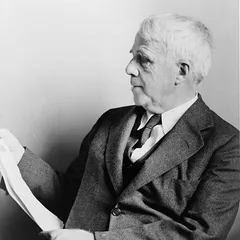
Robert Frost
American · 1874–1963 · Poet
Portrait: Fred Palumbo, World Telegram staff photographer, Public domain, via Wikimedia Commons
A New England poet who used plain talk and strict meter to write about farms, woods, and choices, and who won four Pulitzer Prizes.
Why read Robert Frost?
Frost’s poems sound like a neighbor talking, but the meter underneath is exact, and the plain surface usually hides a harder thought. Mending Wall and Birches are longer blank-verse poems, one about two neighbors repairing a stone wall and one about a boy swinging on birch trees, Out, Out— tells of a boy’s accident with a buzz saw in a few dozen lines, and The Road Not Taken is famous partly for being misread as simple advice. Stopping by Woods on a Snowy Evening, Nothing Gold Can Stay, Fire and Ice, and Acquainted with the Night are short enough to learn by heart, and each turns on a single image. Read them aloud to hear how the rhythm carries the meaning.
A life in six dates
- 1874Born in San Francisco
- 1885After his father’s death, moves with his mother and sister to Massachusetts
- 1913Publishes his first book, A Boy’s Will, in London, after moving his family to England
- 1914Publishes North of Boston, which includes Mending Wall
- 1916Publishes Mountain Interval, with The Road Not Taken and Birches
- 1924Wins the first of his four Pulitzer Prizes, for New Hampshire
- 1961Recites a poem at the inauguration of President John F. Kennedy
- 1963Dies in Boston