Meet the Author
William Blake
English · 1757–1827 · Poet, engraver, and painter
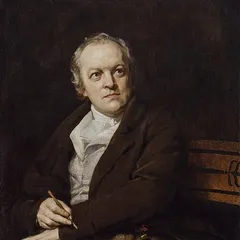
Portrait: Thomas Phillips, Public domain, via Wikimedia Commons
A London poet and engraver who printed his own books, so that each poem arrives inside the picture he made for it.
4 StoryBites Editions4 Poems
Why read William Blake?
Blake writes in short lines and plain words that stay hard to settle. The Tyger asks who could have made such a creature and never answers, while The Lamb, from the earlier book, asks a similar question and answers it at once. London walks a city where every street is mapped and every voice carries the same misery. Read the poems in pairs, since Blake printed the two books together and meant them to be read against each other.
A life in six dates
- 1757Born in London, the son of a hosier
- 1772Apprenticed to the engraver James Basire for seven years
- 1782Marries Catherine Boucher, who helps print and color his books
- 1789Prints Songs of Innocence by his own method of illuminated printing
- 1794Prints Songs of Experience and issues the two books together
- 1804Tried for sedition at Chichester after a quarrel with a soldier, and acquitted
- 1827Dies in London
Themes across the collection
The StoryBites Editions
Context that actually matters
Illuminated printingBlake etched the words and the design onto a single copper plate, printed the sheets himself, and colored them by hand, so the picture is part of the poem.
Songs of Innocence and of ExperienceFrom 1794 Blake issued the two books as one, under a title page promising to show ‘the Two Contrary States of the Human Soul,’ and poems in one book answer poems in the other.
Chimney sweepsSmall boys were apprenticed to master sweeps and sent up narrow flues, a trade Blake attacks in a poem of that title in each of the two books.