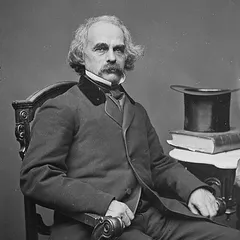
Nathaniel Hawthorne
American · 1804–1864 · Novelist & short-story writer
Portrait: Mathew Benjamin Brady, Public domain, via Wikimedia Commons
The chronicler of Puritan guilt who turned New England's moral shadows into fiction.
Why read Nathaniel Hawthorne?
Hawthorne was haunted by inherited sin, secret shame, and the way communities punish the people who step out of line — his own ancestors judged the Salem witch trials, and he never got over it. His stories work as dark allegories where a birthmark, a black veil, or a scarlet letter carries impossible moral weight. Read him for symbolism that still makes readers argue about what it means.
A life in six dates
- 1804Born in Salem, Massachusetts
- 1835'Young Goodman Brown' published
- 1850'The Scarlet Letter' published
- 1851'The House of the Seven Gables' appears
- 1864Dies in Plymouth, New Hampshire
Nathaniel Hawthorne’s life
Nathaniel Hawthorne was born in Salem, Massachusetts, on July 4, 1804. An ancestor, John Hathorne, was a judge at the Salem witch trials. The young writer later added a “w” to the family name; the change is often linked to that history, though no clear evidence shows that was his reason. His father, a sea captain, died of yellow fever in Suriname in 1808. At Bowdoin College in Maine he became lifelong friends with Franklin Pierce, the future president, and Horatio Bridge. Henry Wadsworth Longfellow was a classmate, but their friendship began only in 1837.
After college he went home to Salem and spent about twelve years reading and writing, living a largely solitary life. He paid to publish a first novel, Fanshawe (1828), and later disowned it. Twice-Told Tales (1837) collected stories he had first published without his name in magazines and gift books, including The Minister’s Black Veil and Dr. Heidegger’s Experiment. He worked at the Boston Custom House, lived for some months at the Brook Farm commune, married the painter Sophia Peabody in 1842 and moved into the Old Manse in Concord. Mosses from an Old Manse (1846) gathered Young Goodman Brown, The Birthmark and Rappaccini’s Daughter.
Dismissed as surveyor of the Salem Custom House when the Whigs took power in 1849, he wrote The Scarlet Letter (1850), which made him famous, then The House of the Seven Gables (1851) and The Blithedale Romance (1852). Herman Melville met him in the Berkshires in 1850 and dedicated Moby-Dick to him. Hawthorne wrote a campaign biography for Pierce, who made him American consul in Liverpool, and after years in England and Italy he published his last finished novel, The Marble Faun (1860). He died in 1864 in Plymouth, New Hampshire, while traveling with Pierce.
Nathaniel Hawthorne’s books and major works
- 1835 Young Goodman BrownStoryOn StoryBites A young Puritan leaves his wife, Faith, for one night in the forest and comes back unable to trust anyone.
- 1836 The Minister’s Black VeilStoryOn StoryBites A minister puts on a black veil one Sunday and never takes it off, and his congregation cannot bear it.
- 1837 Dr. Heidegger’s ExperimentStoryOn StoryBites Four old friends drink water from the Fountain of Youth and repeat every folly of their youth.
- 1837 Twice-Told TalesStories His first story collection, enlarged to two volumes in 1842. Edgar Allan Poe reviewed the 1842 edition and said the tales “belong to the highest region of Art.”
- 1843 The BirthmarkStoryOn StoryBites A scientist cannot stand the small hand-shaped mark on his wife’s cheek and sets out to remove it.
- 1844 Rappaccini’s DaughterStoryOn StoryBites A student in Padua falls in love with a girl raised among her father’s poisonous plants, and grown poisonous herself.
- 1846 Mosses from an Old ManseStories The collection that gathered Young Goodman Brown, The Birthmark and Rappaccini’s Daughter; Melville’s essay on it called Hawthorne a writer of “blackness”.
- 1850 The Scarlet LetterNovelOn StoryBites Hester Prynne wears the letter A in Puritan Boston while the father of her child stands in the pulpit and says nothing.
- 1850 Ethan BrandStory A lime-burner left home to find the Unpardonable Sin and found it in himself: an intellect that lost its sympathy with other people. Collected in The Snow-Image (1851).
- 1851 The House of the Seven GablesNovel A family in an old New England town much like Salem lives under the curse of an ancestor’s crime, and for once Hawthorne lets the ending into daylight.
- 1852 The Blithedale RomanceNovel A novel set on a utopian farm commune and drawn from his months at Brook Farm, though Hawthorne played down the connection.
- 1860 The Marble FaunNovel Three artists in Rome, two of them American, an innocent young Italian count and a murder. His last finished novel.
How Nathaniel Hawthorne writes
Hawthorne called his longer books romances rather than novels, and claimed the romance’s freedom to mix the everyday with the marvelous. In practice that means allegory with the edges blurred. He offers explanations and then withdraws them: Goodman Brown may only have dreamed the witch meeting, and the minister’s veil may hide one sin or everyone’s.
Objects carry the meaning: a pink ribbon, a veil, a birthmark shaped like a small hand, a scarlet letter. The prose comes back to them again and again until they glow. His sentences are long, formal and quietly ironic, and the narrator often seems to know more than he is willing to say.
What runs through the work
Hidden sin, public virtue
Mr. Hooper’s veil, Dimmesdale’s silence and Goodman Brown’s night in the forest ask the same question: what does a respectable community hide, and what happens to the person who sees it? Hawthorne’s answers are rarely comforting.
The Minister’s Black Veil · The Scarlet Letter · Young Goodman Brown
The experimenter
Aylmer in The Birthmark, Rappaccini in his garden of poisons and Dr. Heidegger with his water from the Fountain of Youth all treat people as material for an experiment. In “Ethan Brand” Hawthorne gave the result a name, the Unpardonable Sin: a mind that has stopped feeling for anyone.
The Birthmark · Rappaccini’s Daughter · Dr. Heidegger’s Experiment
The Puritan past
Much of his best-known fiction is set in Puritan New England, among the people his own family came from. He neither celebrates nor simply condemns them. He shows how a society built on watching its members for sin produces hypocrites and outcasts.
Isolation
Hester on the edge of town, Hooper behind his veil, Beatrice shut in her father’s garden: Hawthorne’s people are cut off, sometimes by others and sometimes by their own choice, and he treats that separation as both a punishment and a danger.
Sources
The dates, titles and quotations in this guide were checked against these sources in November 2026. Found a mistake? Every fix is logged on Corrections.
- Hawthorne in Salem, “Biography” (North Shore Community College Library)
- National Park Service, Salem Maritime NHS, “Nathaniel Hawthorne”
- National Park Service, “Henry Wadsworth Longfellow and Nathaniel Hawthorne”
- Edgar Allan Poe, review of Twice-Told Tales, Graham’s Magazine, May 1842 (Edgar Allan Poe Society of Baltimore)
- Herman Melville, “Hawthorne and His Mosses”, The Literary World, 1850
- Project Gutenberg, Mosses from an Old Manse
Themes across the collection
The StoryBites Editions
Context that actually matters
Influence
Echoes of Nathaniel Hawthorne run through Herman Melville, Henry James, Flannery O'Connor, among many others.