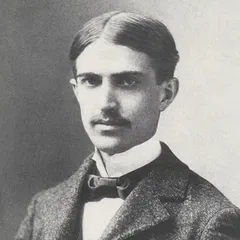
Stephen Crane
American · 1871–1900 · Novelist, short-story writer & poet
Portrait: Unknown author, Public domain, via Wikimedia Commons
A young naturalist who wrote war and want with a cold, unblinking eye and died at 28.
Why read Stephen Crane?
Crane treated human beings as small figures buffeted by indifferent forces — war, weather, poverty — and refused to sentimentalize their struggle. His prose is vivid and ironic, full of sharp color and sudden reversals of luck. Read him for stories that stare hard at courage, fear, and the universe's total lack of interest in our survival.
A life in six dates
- 1871Born in Newark, New Jersey
- 1893Self-publishes 'Maggie: A Girl of the Streets'
- 1895'The Red Badge of Courage' brings him fame
- 1897'The Open Boat' published after surviving a shipwreck
- 1900Dies of tuberculosis at 28 in Germany
Stephen Crane’s life
Stephen Crane was born in Newark, New Jersey, in 1871, the fourteenth and last child of a Methodist minister and a mother active in the temperance movement. He spent a semester at Lafayette College and another at Syracuse University, where he played on the baseball team, then went to New York as a freelance reporter. He came to know the Bowery well and wrote about it, and in 1893 paid a printer to publish his first novel, Maggie: A Girl of the Streets, under a false name.
The Red Badge of Courage, published in October 1895 when he was twenty-three, made him famous within months. He had never seen a battle when he wrote it. At the start of 1897, on his way to Cuba as a newspaper correspondent, the steamer Commodore, running guns to Cuban rebels, sank off the coast of Florida. Crane spent some thirty hours in a ten-foot dinghy with the captain, the cook and an oiler, and the oiler drowned in the surf at Daytona. The story he made of it, The Open Boat, is often called his finest short story. Later that year he reported the war between Greece and Turkey, and in 1898 the Spanish-American War in Cuba.
He spent his last years in England, at Brede Place in Sussex, as a friend of Joseph Conrad, H. G. Wells and Henry James, writing fast to pay his debts. He died of tuberculosis at the spa town of Badenweiler, Germany, in June 1900. He was twenty-eight.
Stephen Crane’s books and major works
- 1893 Maggie: A Girl of the StreetsNovella A girl from a violent Bowery tenement is ruined by her family, her neighborhood and the man she trusts. Crane paid to have it printed under the name “Johnston Smith”.
- 1894 The Men in the StormSketchOn StoryBites Homeless men wait in a New York blizzard for a shelter door to open. Read through Karen Bernardo’s analysis.
- 1895 The Red Badge of CourageNovelOn StoryBites Henry Fleming runs from his first Civil War battle and gets his “red badge”, a head wound, from a fleeing Union soldier’s rifle.
- 1895 The Black Riders and Other LinesPoems Short, unrhymed, unsparing poems that critics see as forerunners of the Imagist poets.
- 1897 The Open BoatStoryOn StoryBites Four shipwrecked men in a dinghy within sight of the Florida shore, drawn from Crane’s own wreck.
- 1898 The Bride Comes to Yellow SkyStoryOn StoryBites A Texas marshal brings home a bride and meets the town’s drunken gunman on the way from the station.
- 1898 The MonsterNovella In Whilomville, a small New York town, Henry Johnson, the Black man who cares for the doctor’s horses, is disfigured saving the doctor’s son from a fire, and the doctor’s loyalty to him costs the family the town’s goodwill.
- 1898 The Blue HotelStoryOn StoryBites A frightened Swede at a Nebraska hotel is sure he will be killed, and his fear helps make it happen.
- 1899 War Is KindPoems His second book of poems; the title poem turns its own refrain into bitter irony.
- 1900 Whilomville StoriesStories Boyhood stories set in the same town as The Monster, published the year he died.
How Stephen Crane writes
Crane writes in sharp, separate pictures, letting color do the work other writers gave to explanation, which is why critics call him an impressionist. The Open Boat begins: “None of them knew the color of the sky.” The men are too busy watching the waves to look up, and the sentence says so without saying it.
His narrators keep an ironic distance from what their characters feel. Henry Fleming’s heroic daydreams are reported with a straight face and quietly deflated. Crane also takes the large words of romance, courage, destiny, the Wild West, and tests them against what actually happens: in The Bride Comes to Yellow Sky the gunfight everyone expects never takes place.
What runs through the work
An indifferent universe
In The Open Boat the correspondent realizes that “nature does not regard him as important.” To the correspondent, the wind tower on the shore represents “the serenity of nature amid the struggles of the individual.” This is literary naturalism: people shaped by forces that do not notice them.
Courage and the story told afterward
Henry Fleming’s wound comes from his own side, yet he tells the regiment he was shot, and his comrades take it for a bullet graze. The novel asks less whether a man is brave than what story he tells himself about it later.
Brotherhood under pressure
The four men in the dinghy form what Crane calls “the subtle brotherhood of men”, and the correspondent, “taught to be cynical of men”, knows even at the time that it is “the best experience of his life.”
Who is to blame
The Blue Hotel ends with the Easterner insisting that “every sin is the result of a collaboration”. He spreads the guilt for the Swede’s death across five men: Johnnie, who cheated at cards; the Easterner himself, who saw it and said nothing; the cowboy, who wanted the fight; old Scully; and the gambler who stabbed him. It is one of Crane’s sharpest questions about shared responsibility.
The end of the Old West
The Bride Comes to Yellow Sky plays the western straight until the showdown, then lets it fizzle: the marshal has married and stepped into a different story, and the gunman has no part in it.
Sources
The dates, titles and quotations in this guide were checked against these sources in November 2026. Found a mistake? Every fix is logged on Corrections.
- Stephen Crane Society, “Stephen Crane Almanac” (from The Crane Log)
- Library of America, “Stephen Crane’s Own Story” (2023)
- Poetry Foundation, “Stephen Crane”
- Reference Guide to Short Fiction (Gale), “Crane, Stephen”, via Encyclopedia.com
- Project Gutenberg, The Red Badge of Courage
- Project Gutenberg, Men, Women and Boats (The Open Boat, The Blue Hotel)
Themes across the collection
The StoryBites Editions
Context that actually matters
Influence
Echoes of Stephen Crane run through Ernest Hemingway, among many others.